
The 20 hospitals with the highest dissatisfaction rates in America

Here are the twenty hospitals in America with the lowest recommendation rates by patients whom they serve, according to data from the official HCAHPS survey, accessed October 2013 from the Medicare data website:
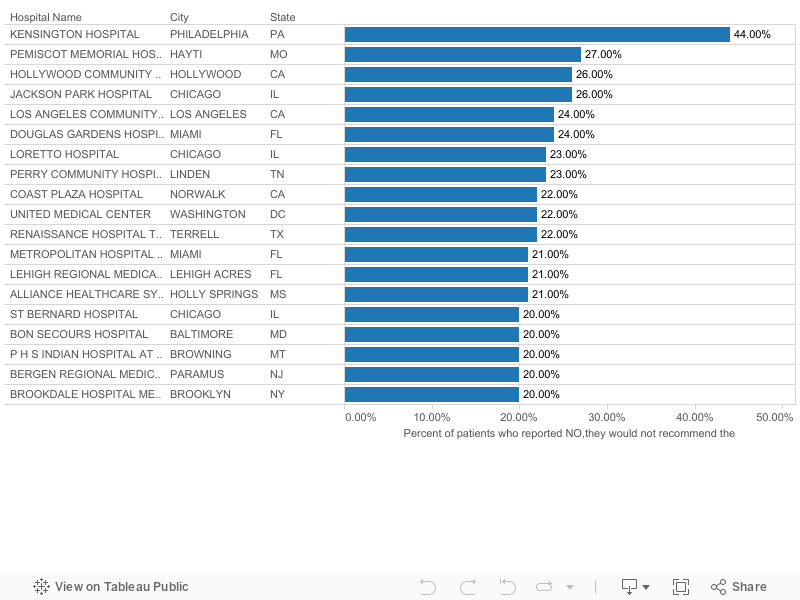
What is "HCAHPS"? HCAHPS is best explained by their own fact sheet:
The HCAHPS (Hospital Consumer Assessment of Healthcare Providers and Systems) Survey is the first national, standardized, publicly reported survey of patients' perspectives of hospital care... While many hospitals have collected information on patient satisfaction for their own internal use, until HCAHPS there were no common metrics and no national standards for collecting and publicly reporting information about patient experience of care. Since 2008, HCAHPS has allowed valid comparisons to be made across hospitals locally, regionally and nationally. 
Why is HCAHPS important? The answer is "money". Again, from the fact sheet:
HCAHPS and Hospital Value-Based Purchasing. The FY 2014 Hospital Value-Based Purchasing (Hospital VBP) program links a portion of IPPS hospitals' payment from CMS to performance on a set of quality measures, which include the Clinical Process of Care Domain, which accounts for 45% of a hospital’s Total Performance Score (TPS); the Patient Experience of Care Domain, 30% of TPS; and the new Outcome Domain, 25% of TPS. The HCAHPS Survey is the basis of the Patient Experience of Care Domain. 

Comments

Popular posts from this blog

IEEPA Tariff Refund Checklist (2026): How U.S. Importers Can Recover Duties Without Missing Deadlines

 If your company paid IEEPA-related import duties in 2025–2026, the biggest risk right now is not “whether refunds exist.” The biggest risk is operational: teams miss filing windows, submit incomplete data, or assume refunds are automatic. They’re not. Recent legal and agency developments created meaningful refund opportunities for many importers. But recovery still depends on entry-level details, liquidation posture, and execution quality. This guide gives you a practical, deadline-first checklist to maximize recoverable dollars while minimizing avoidable errors. Important: This article is informational and not legal advice. Why this matters now Three facts can all be true at once: The Supreme Court changed the legal landscape for IEEPA tariffs. CBP is operationalizing refunds through staged systems and rules. Importers can still lose rights if they wait too long or file the wrong pathway. In plain English: the legal headline helped, but workflow discipline still de...

Dr. Alex Mohseni invited to speak at Brault’s Healthcare Leadership Forum about the future of Emergency Medicine services and how ED groups can adapt using telemedicine.

  Dr. Mohseni presented on the topic of how Emergency Medicine groups could expand their scope of practice to the virtual space to and how to do so in a financially viable way.

From Stethoscope to Strategy: Why I Built ClinX Academy for Physicians Ready to Lead

“I love medicine—but I don’t love the hamster wheel.” That sentence kept echoing in my head during 3 a.m. shifts and budget meetings alike. If you’re a physician feeling the same tug between clinical passion and systemic frustration, this post is for you. The Problem: Brilliant Clinicians, Limited Business Training Physicians command >80 % of U.S. healthcare spend yet hold <5 % of C-suite seats. Traditional MBAs cost $150K+, 2 years, and countless missed family dinners. Weekend “crash courses” often lack depth, CME credit, or a meaningful network. Burnout rates hover around 50 % —and much of it stems from feeling powerless in operational decisions. Keywords: physician leadership gap, physician executive training, clinician burnout, healthcare MBA alternative, non-clinical career paths My A-Ha Moment in the Hospital Corridor I was serving as a National Medical Director when a perfectly capable colleague admitted, “I have no idea how capitation works—I just sign ...